Credits required
120
Cost per-credit*
$312.75
Delivery
Online

120
$312.75
Online
For students interested in understanding individuals, families, and communities across diverse contexts, this Bachelor of Science degree offers a focused and applied pathway forward. The Human Development and Family Science (HDFS) program uses an interdisciplinary and dynamic social science framework to examine development, family systems and relationships, diversity, ethics, well-being across the lifespan, and prevention-focused family life education across varied cultural and social contexts.
The program is intentionally designed to foster strong faculty connection and mentorship, with an emphasis on community-engaged field experiences thatallow students to apply theory to practice. Designed as an undergraduate major delivered from the College of Education and Human Development through Nevada Online, this programallows students to continue working, caring for family or staying rooted in their community while completing a degree in human development that aligns with long-term career goals.
*Program tuition. Base in-state tuition cost. Fees may apply. Net tuition varies by student. Learn more about tuition and fees.


Across education, healthcare, and community-based services, there is a growing demand for professionals who can navigate complex social challenges, strengthen families,and support wellbeing across the lifespan. Organizations increasingly rely on practitioners who understand individual and family systems and who can apply evidence-based, ethically grounded decision-making in real-world settings.
As a Human Development and Family Science (HDFS) major, students are prepared to meet these needs by integrating theory, research, and hands-on, community-engaged learning.This interdisciplinary training equips graduates to support children, adolescents, and families in diverse communities and to respond effectively to today’s evolving social, health, and educational challenges.
Students in the human development and family science program build a strong foundation in lifespan development, family relations and research literacy. Core courses explore how individuals grow from infancy through adulthood while advanced courses focus on family interactions, marriage and family relationships and applied practice.
Throughout the HDFS core, students learn to evaluate research, translate findings into practice and communicate effectively in professional settings. This approach prepares students for meaningful careers and graduate programs in fields connected to family services and human development.
You will graduate ready to:
The HDFS major emphasizes hands-on experiential learning that connects coursework to professional experience. Students who wish to gain practical skills can participatein service-learning and community-engaged, supervised internships and practicum experiences that support career readiness and pre-professional personal development.
These learning opportunities build confidence and prepare students to work with children, families, and community organizations.
The curriculum includes core courses and advanced courses that address development, family systems and applied practice. Courses required for the major in HDFS span infancy, childhood and adolescence while also addressing family resource management, parenting and family interaction.
Sample course topics include:
| Course | Summary |
|---|---|
| Lifespan Human Development | Overview of growth and development from the prenatal period through adulthood. |
| Introduction to Families | Dynamics of development, interaction and intimacy of primary relationships in contextual and theoretical frameworks. Societal issues and choices facing diverse family systems. |
| Advanced Human Development - Infancy | Theory, research, and issues in infancy. |
| Advanced Human Development - Childhood | Development of children from age 3 to preadolescence, with an emphasis on research, theory and application. |
| Advanced Human Development - Adolescence | Theory, research, and issues in adolescence. |
| Practicum with Children and Families | Observing and working with children, adults or families in a supervised setting. |
| Family Interaction | Review of research and theory on family dynamics, interactions, and processes. In addition, application of concepts and assessments via theory application and assessment of family interactions, as well as application of culture to broader global family contexts. |
| Child Guidance and Parenting | Guiding the behavior of children from infancy through adolescence using child development principles appropriate for teachers, parents, and others working with children. |
| Early Childhood Education | Principles of working with young children in child care, Head Start, and other group settings. Introduction to environment, curriculum, and guidance. |
| Family Resource Management | Theory and application in the identification and allocation of human and nonhuman resources. Decision making, communication, time and financial management. |
Students may also explore learning opportunities connected to research labs, research with HDFS faculty, study abroad and service learning depending on availability and interests.
Graduates of the Human Development and Family Science, B.S. are prepared for a wide range of growing roles in social services, education, community programs and healthcare settings that support individuals and families across the lifespan. Employment in the broader healthcare and social assistance sector continues to expand nationally, driven by increasing demand for supportive services and professionals trained to work with diverse populations.
This degree equips students with versatile skills that open pathways into child and family advocacy, community outreach, behavioral health support, early childhood services and other human‑centered professions with strong long‑term need.
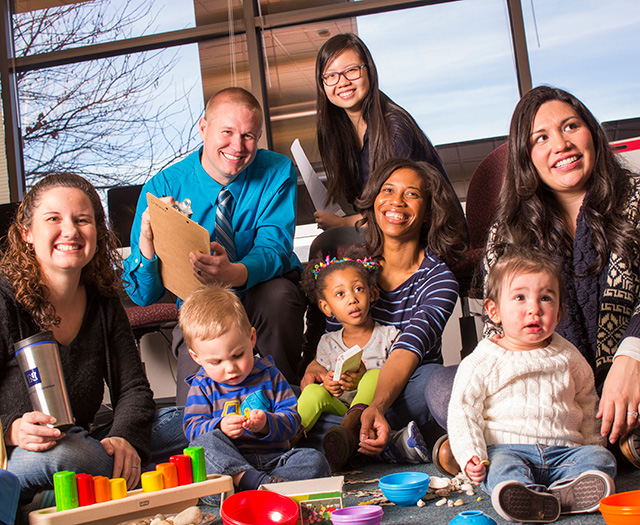
The HDFS program prepares students for graduate study in counseling, social work, family therapy, family law, occupational therapy and related graduate programs in fields connected to human development and family science.
Students interested in certified family life education or becoming a certified family life educator benefit from coursework aligned with standards set by the National Council on Family Relations.
This major is not a teacher-preparation program.
Undergraduate students transferring into the program can plan efficiently through established degree options and major-to-major transfer agreements with TMCC, WNC, GBC and CSN. To graduate, students must complete 30 upper-division credits at the University, including at least 15 upper-division credits in the HDFS major. Students may also complete a major or minor combination to tailor academic preparation. Academic advisors help students navigate general education requirements, courses required for the major and long-term degree planning.
This program combines research-driven instruction with practical preparation grounded in human development and family sciences. Through Nevada Online, undergraduate students gain access to a respected bachelor of science degree while building skills that prepare students to work with children, families and communities in meaningful ways.
Classes taught by University of Nevada, Reno faculty
Access to a Carnegie® R1 research university
Choose from accessible, fully online programs
Continue your education from anywhere in the world, free from a fixed schedule